
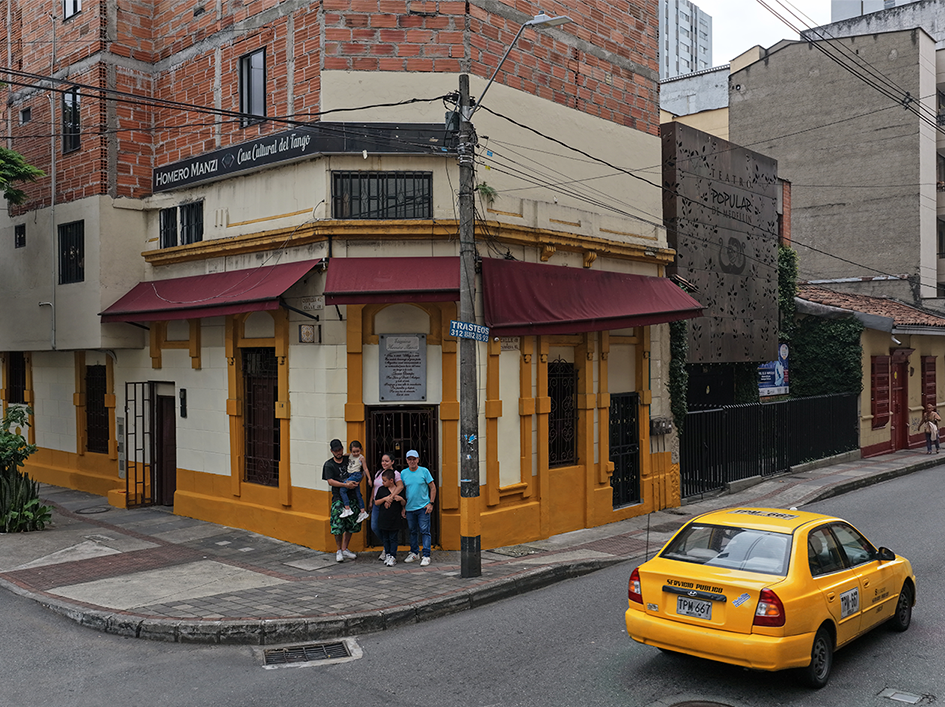
Casa Cultural del Tango Homero Manzi: A Benchmark for Tango and History in Downtown Medellín
Downtown Medellín has corners that hold stories going far beyond everyday commerce. At the intersection of 48th Street (Pichincha) and 41st Avenue, lies a place that has stood firm against the city’s constant changes: La Casa Cultural del Tango Homero Manzi. This space is not simply a tango bar; it is a meeting point that preserves one of the deepest traditions of the Antioqueño identity.
To understand why this place matters, there is no need to rely on romantic clichés. It is enough to look at its history and the way it has connected two cultures—the Rioplatense and the Paisa—through words and music.
Who was Homero Manzi and why is he named in Medellín?
Bearing the name of Homero Manzi is a statement of principles. Unlike other tango lyricists who focused on crime stories or a language exclusive to Buenos Aires, Manzi was a poet who wrote about the neighborhood, nostalgia, and the lives of ordinary people. His lyrics, like those of the famous tangos “Sur” or “Barrio de tango”, resonated strongly in Medellín because they spoke of universal realities: changing cities, the loss of childhood places, and the melancholy of progress.
In Medellín, tango stopped being an imported genre and became something deeply local starting in the 1930s. The city’s industrialization brought many people from the countryside to the factories, and during that transition, tango served as a language to express their sense of displacement. La Casa Cultural del Tango Homero Manzi was founded in 1987 precisely to honor that bond, inspired by the mystique of Buenos Aires cafés but with a profoundly local root.
A story born from personal passion
The origin of this cultural center is an example of how one person’s passion can become a city’s heritage. Its founder, Francisco Javier Ocampo, opened the place inspired by the bohemian spirit of Argentina, starting with just four tables in a corner of his home. What began as a sanctuary for close friends and aficionados of the genre—among them Don Orlando Loaiza—grew organically to occupy the entire ground floor of the building.
Today, that preservation work is carried forward by Don Orlando, who has been leading the establishment for over 34 years. His dedication has been key to keeping Homero Manzi alive. Currently, he counts on the support of his daughter, Shirley, ensuring that the knowledge and management of the place remain family-run. This continuity is vital because it allows the site to keep its essence: here, the goal is not to follow passing trends, but to maintain a standard of quality and a respect for history that visitors notice the moment they step inside.
A living museum inside the house
Upon entering Homero Manzi, visitors are met with a collection of over 80 paintings that offer a true visual history lesson. They are not there for mere decoration; each image of Gardel, Troilo, or Manzi himself tells a chapter in the development of tango. The walls are also marked by verses and poems that invite a slow read while enjoying a drink.
The atmosphere is professional and quiet during the day, ideal for those seeking a conversation or simply wanting to observe the traditional architecture of the house, with its high ceilings and iron bars. It is a space that invites you to understand tango through its lyrics and reflection, rather than as a mass spectacle.
A cultural circuit in the heart of downtown
One of the great advantages of La Casa Cultural del Tango Homero Manzi is its location. It sits in an area that has experienced a renewed cultural relevance in recent years. Just two blocks away is Pasaje Cervantes, a very active pedestrian corridor where local design, literature, and Medellín’s young bohemian scene converge.
Additionally, the Manzi is part of a nearby circuit of spaces, including La Pascasia, Teatro Popular de Medellín, La Rueda Flotante, Teatro Matacandelas, and El Pequeño Teatro, along with several other venues that have emerged in recent years to offer a diverse cultural scene. This means that a visit to La Casa Cultural Homero Manzi is never an isolated plan, but part of a journey through the heart of the city. Being close to the Torres de Bomboná and major transport routes like the Ayacucho Tram makes it easy for both locals and tourists to come and discover this cultural project.
The weekend experience: Singing and dancing
While the house remains a steady spot for quiet conversation during the week, the atmosphere shifts on Fridays and Saturdays to welcome live performances. On these nights, Homero Manzi offers live singing, dancing, or both, depending on the schedule.
It is worth noting that these shows steer clear of commercial tropes and focus heavily on authenticity. The performing artists are seasoned experts in the genre who build a genuine, close connection with the audience. Watching tango being danced in a space with these dimensions and this kind of history is a completely different experience from watching a show in a massive theater. Here, the intimacy allows you to appreciate the finer details, the technique, and, above all, the raw emotion that tango conveys.
Why visit La Casa Cultural Homero Manzi?
The importance of this place lies in its capacity for resilience. In a constantly transforming city, having a space that preserves a century of musical and poetic memory is an invaluable cultural asset. It is not an exclusive club for tango scholars; it is an open door for anyone wanting to learn a bit more about the history of Medellín and enjoy an authentic environment.
Going to Homero Manzi is a direct way to support local culture and connect with people like Don Orlando and Shirley, who work every day to keep these spaces alive. It is an invitation to rediscover downtown from a different perspective—one that is slower paced and grounded in real historical depth.
If you are looking to understand why Medellín remains one of the tango capitals of the world, or if you simply want to experience a different kind of Friday night listening to great music in an environment that respects its roots, this cultural center is the place to be. It is an essential stop to realize that tango is not just something that happened in the past, but something that continues to happen every single day on this corner of the Aburrá Valley.